
42events: Designing a Unified Event Planning Platform
The Problem
Event planning in India was almost entirely word-of-mouth and broker-dependent. There was no reliable way to compare venues on structured criteria – a planner looking for a venue for 500 guests that could do a Cocktail Reception layout with halal catering had no choice but to call fifteen venues individually.
The information asymmetry between vendors and planners was the core problem. 42events was built to close that gap – but only if the search and filtering experience was precise enough to actually surface the right matches.
My Approach
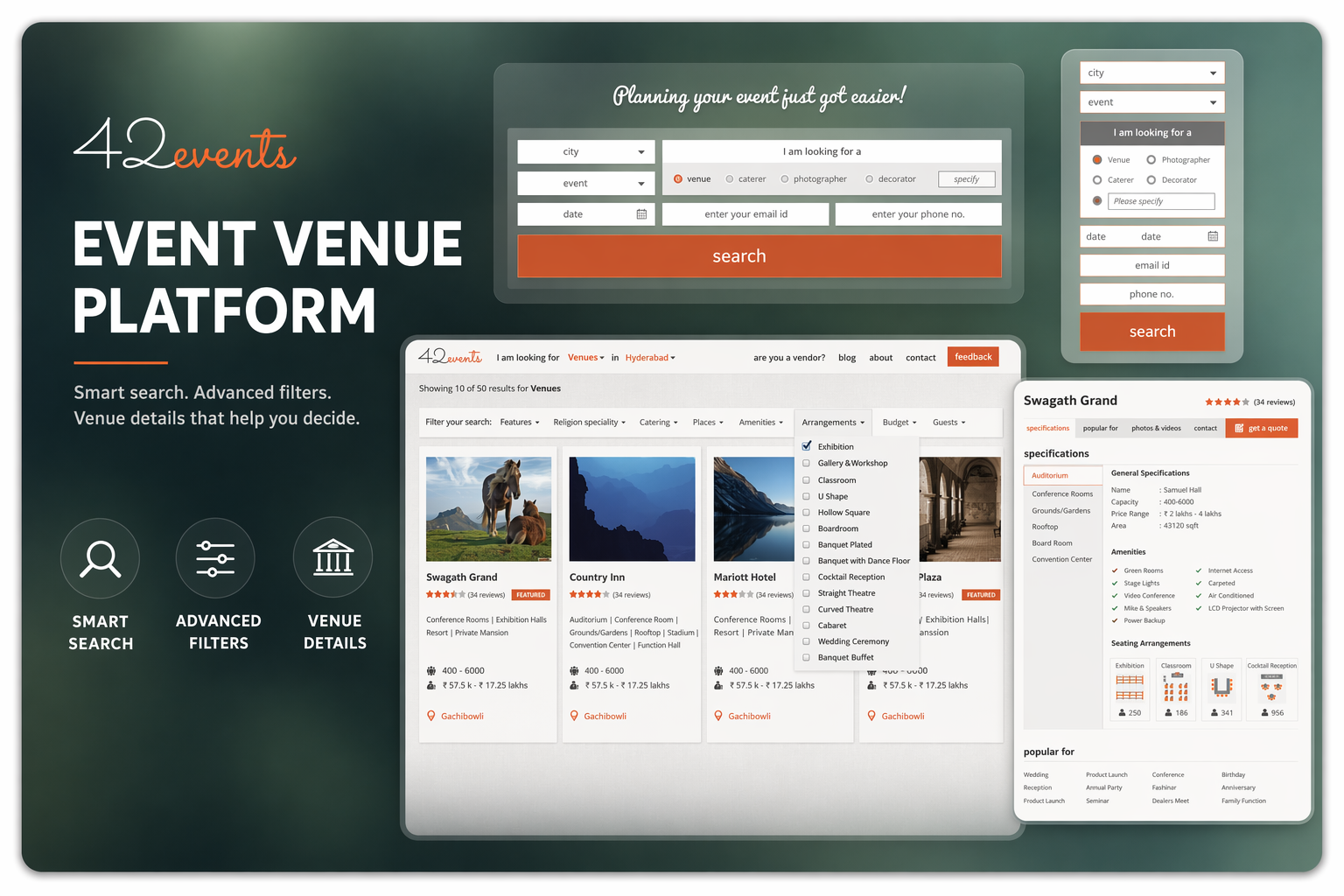
I designed the end-to-end search experience starting from the landing page – a dual-layout search form with city, event type, vendor category, date, and contact fields.
The search results architecture required particular care: vendors needed to be filterable across seven dimensions simultaneously without the interface becoming overwhelming. I designed a dropdown-per-dimension system that kept the results page clean while exposing full filter depth on demand.
The individual venue page went deeper — sub-space navigation, seating arrangement icons with capacity figures, amenities, pricing, and a contact/quote flow.
The Work
Designed two responsive layout variants for the landing page search form. Built out the full search results page with star ratings, featured badges, venue type tags, capacity and price range display, and location indicators. Designed the individual vendor detail page with tabbed navigation (Specifications, Popular For, Photos & Videos, Contact, Clientele, Get a Quote) and the seating arrangements visual system showing layout types with capacity figures.
Evidence of Impact
Delivered a platform that transformed the event planning discovery process from days of relationship-dependent phone calls into minutes of structured, filterable search. The multi-dimensional filter system – covering seating arrangements, budget, guest count, amenities, catering type, and religion speciality — gave planners precise control over matching that hadn't existed before in the Indian event planning market.
What I'd Do Differently
The multi-filter system was comprehensive but cognitively demanding for first-time users. I'd now design a progressive disclosure approach: start with the three highest-signal filters (venue type, guest count, budget) and reveal advanced filters only after the initial results load. I'd also push harder for user testing with actual event planners before launch rather than relying on internal review.