
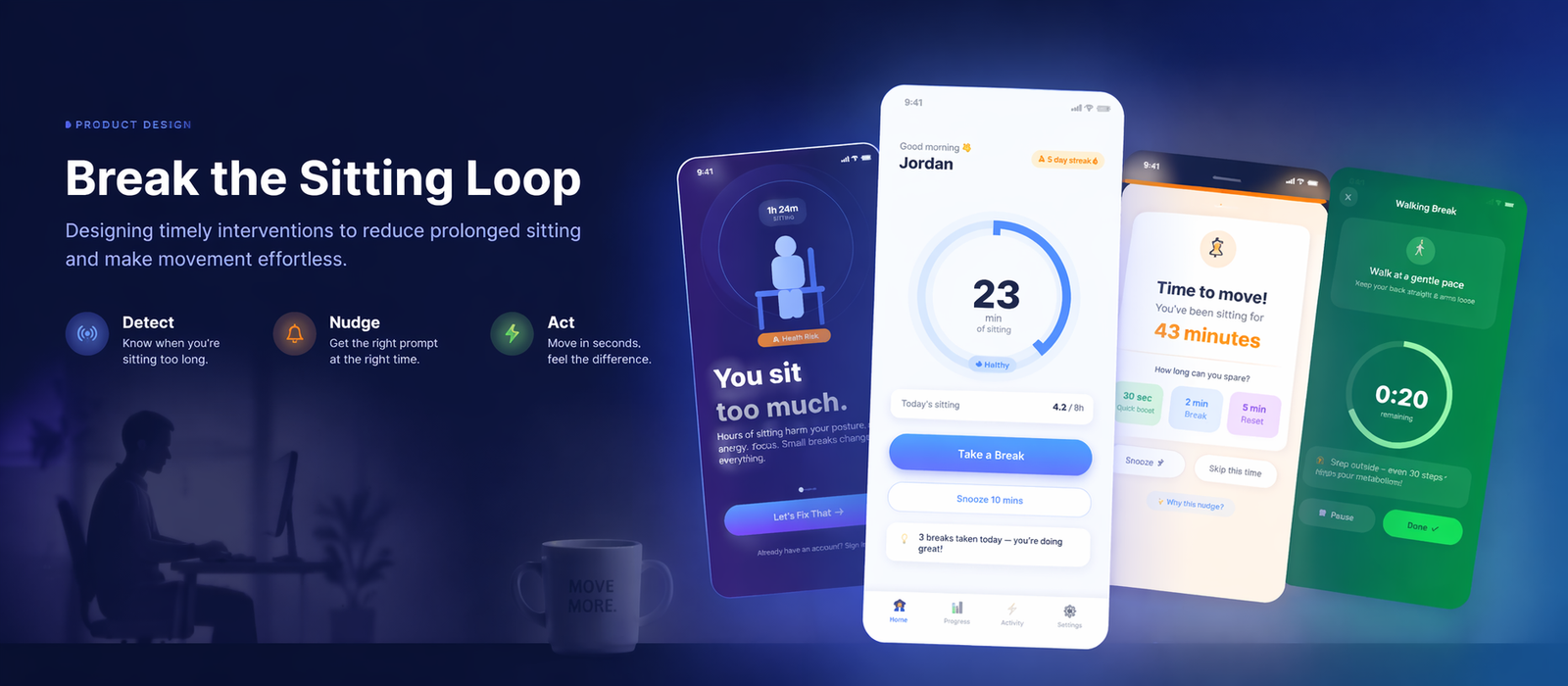
Breaking the Sitting Loop
The Problem
Modern work patterns keep people seated for long periods without clear intervention at the moment behaviour needs to change. Existing solutions typically focus on passive tracking, historical dashboards, or generic reminders.
The gap is simple: awareness exists, but action does not. The challenge was not to show users more data. It was to help them move at the right moment with as little friction as possible.
My Approach
I reframed the product from a tracking app into a behavioural intervention system. Instead of treating sitting as a metric to review later, I designed the experience around a simple loop that pushes users from awareness to action.
Behaviour loop: Detect → Nudge → Act → Reward → Reflect
Three principles guided the design: intervene at the right moment, reduce action to the smallest possible step, and reinforce behaviour without guilt or overload.
The Work
The app uses escalating states to detect inactivity, introduce timely nudges, and guide users through short movement breaks. The experience is intentionally lightweight. It prioritises action over information and speed over feature density.
The screen set includes onboarding, live sitting states, interruption design, activity selection, guided break sessions, reward moments, weekly progress, settings, and transparency around why a nudge occurred.
Evidence of Impact
This is a concept project, so impact is framed through intended behavioural outcomes. The design aims to increase nudge-to-action conversion, reduce average sitting duration, and improve the consistency of short movement breaks.
The core design shift was from “I should move later” to “I can move right now”.
View live project ↗
What I'd Do Differently
Next, I would test adaptive nudge timing, explore context-aware interruptions during meetings or focus periods, and validate the most effective break durations through a longitudinal study. I would also explore wearable integrations to strengthen real-time sensing.