
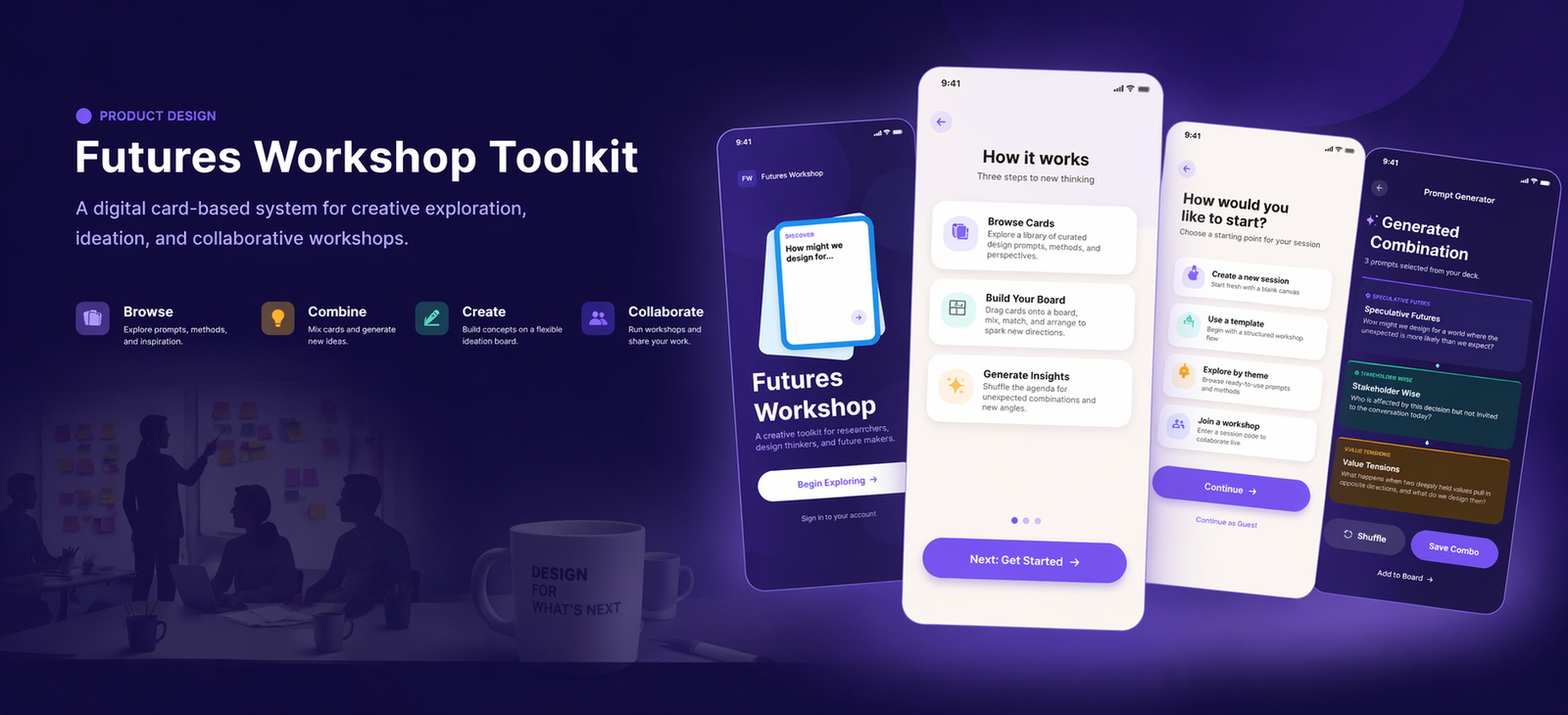
Futures Workshop Toolkit
The Problem
Design workshops and futures thinking sessions often rely on physical card decks, whiteboards, and loosely connected tools. While those formats support creativity, they also create friction when people need to browse prompts, capture notes, compare methods, or return to ideas later.
The challenge was to design a system that preserves the openness of workshop ideation while making exploration, combination, and documentation easier in a digital format.
My Approach
I framed the product as a creative toolkit rather than a productivity app. The goal was not to optimise task completion. It was to support structured exploration without killing generative thinking.
Core experience: Browse → Select → Explore → Combine → Save → Share
The design was guided by three principles: keep the interface lightweight, make prompts easy to recombine, and support both individual reflection and collaborative workshop use.
The Work
The app includes onboarding, a card library, detailed prompt views, an ideation board, a prompt generator, saved sessions, sharing tools, settings, and a live collaborative workshop mode. Each part of the system is designed to help users move from prompt discovery to concept generation with minimal friction.
The UI uses a calm card-based system, clear category tags, simple navigation, and lightweight visual hierarchy. This keeps the experience flexible enough for open-ended idea generation while still giving users enough structure to build and revisit concepts.
Evidence of Impact
This is a concept project, so impact is framed through design intent. The toolkit is designed to reduce the friction of workshop setup, make card-based ideation easier to revisit, and support more fluid transitions between inspiration, exploration, and concept formation.
The key shift was from scattered workshop artefacts to a single digital workspace for prompts, notes, combinations, and outputs.
View live project ↗
What I'd Do Differently
Next, I would test the toolkit in real workshop settings, compare individual versus collaborative use, refine how prompts are generated and combined, and explore tablet or desktop-first versions for more complex facilitation contexts.