
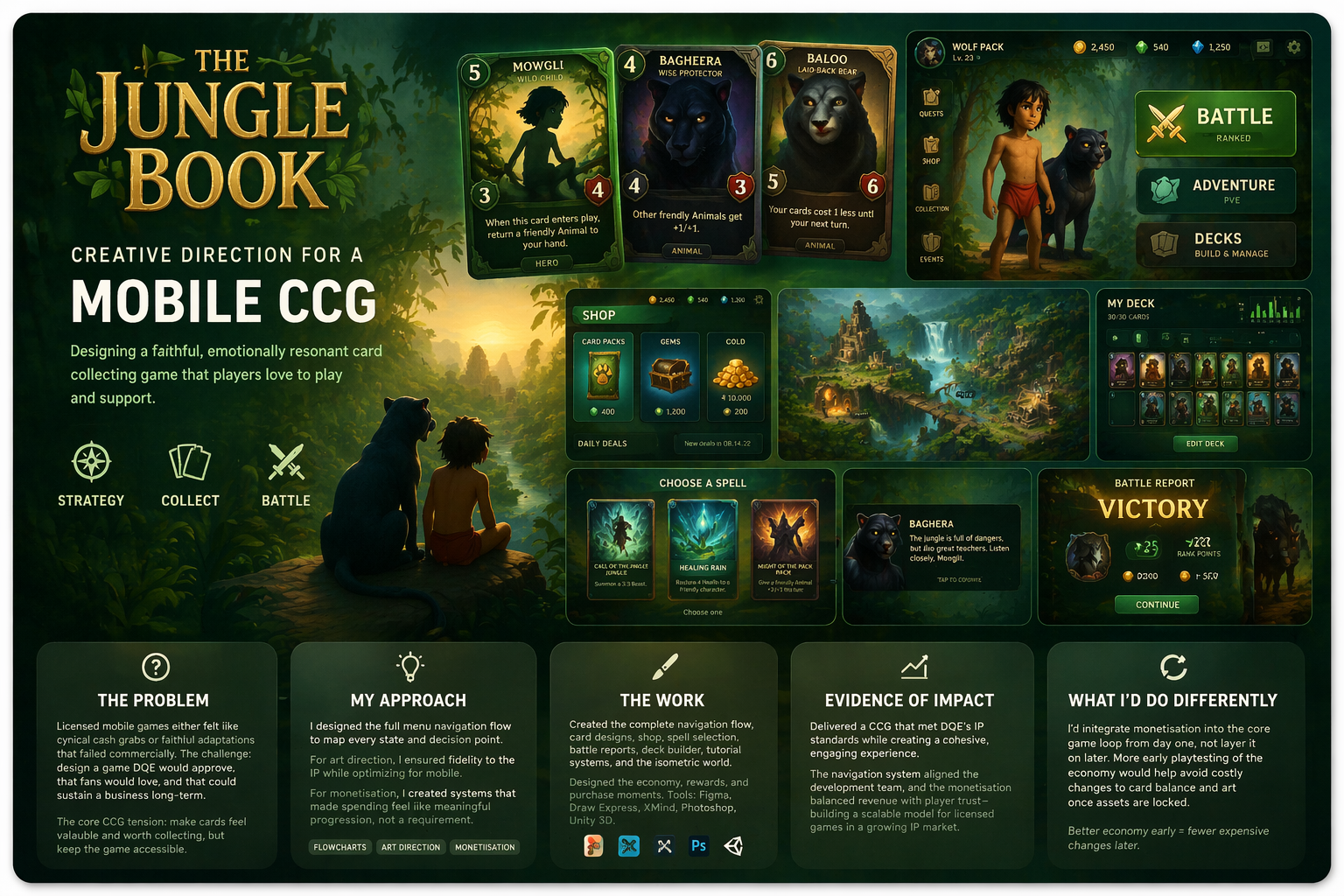
The Jungle Book: Creative Direction for a Mobile CCG
The Problem
Licensed mobile games had a reputation problem — either cynical cash grabs with IP pasted on top, or faithful adaptations that failed commercially because monetisation was an afterthought. The challenge was designing a game DQE would approve, that players who grew up with Jungle Book would connect with emotionally, and that had monetisation mechanics sophisticated enough to sustain the business without burning player trust.
As a CCG, the design also needed to solve the core tension: cards need to feel collectible and scarce enough to drive spending, but accessible enough that new players don't feel locked out of the core game loop.
My Approach
I began by designing the complete menu navigation flow — a complex decision tree covering all game states, user paths, and decision points from onboarding through to advanced deck building and battle. This flowchart became the source of truth for the development team.
For art direction, I worked closely with DQE guidelines to ensure every asset was faithful to the IP while optimised for mobile screen sizes. For monetisation, I designed features that made spending feel like meaningful progression: the in-game shop, spell selection mechanics, and active deck system created natural moments where spending felt like a choice rather than a requirement.
The Work
Produced the full menu navigation flowchart covering all game states. Directed the art team to create character cards, jungle shop UI, spell selection screens, battle report screens, active deck interface, tutorial/dialogue screens, and the isometric game world. Designed the monetisation feature set including in-game economy, reward structures, and purchase moments. Used Figma, Draw Express, and XMind for navigation flows; Photoshop for wireframes; Unity 3D for scene setup.
Evidence of Impact
Delivered a mobile CCG satisfying DQE IP requirements while creating a coherent, engaging game experience. The navigation system gave the development team a clear implementation roadmap. The monetisation design balanced revenue generation with player engagement — building on a collaborative IP model demonstrating a scalable approach to licensed game development in an era when content IP was becoming a key competitive differentiator.
What I'd Do Differently
I'd build the monetisation design into the core game loop from day one rather than layering it on afterwards. The most durable monetisation in CCGs comes from mechanics that make spending feel like progression — I'd spend more time playtesting the economy before art assets were locked, since changing card balance after art direction is complete is enormously expensive.