
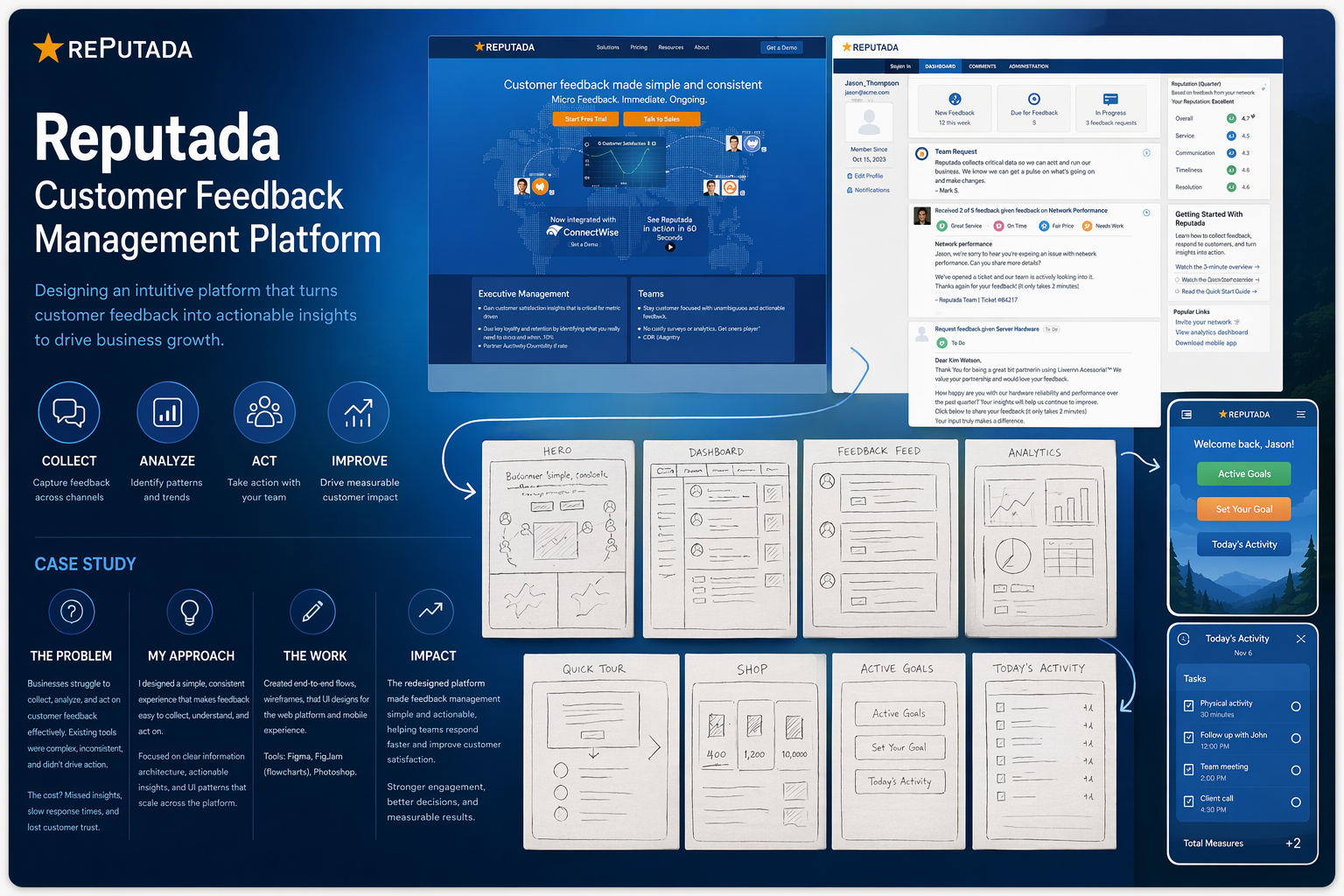
Reputada: Gamified Feedback & Reputation Platform
The Problem
Most feedback tools treat feedback as a data collection problem. Reputada's insight was that feedback is actually a behavioural problem — people don't give useful feedback unless they're in the right psychological and physical state to engage meaningfully.
That's why the health game component wasn't an add-on; it was central to the theory of change. The design challenge was making this connection feel natural rather than forced, and ensuring gamification mechanics were grounded in actual behavioural science rather than superficial points and badges.
My Approach
I used a Design Through Research approach — consulting psychologists to understand the psychological conditions for meaningful feedback, and physical trainers to understand how physical wellbeing affects cognitive engagement and communication quality.
These expert consultations directly informed the user personas, which shaped the health game design: a goal-setting interface (Active Goals, Set Your Goals), daily activity tracking, and a progress system tied to real behavioural milestones rather than arbitrary point accumulation.
The Work
Wrote and maintained design documentation. Designed wireframes for the marketing website and feedback dashboard. Designed the health game UI including Goals screen, Today's Activity checklist, and progress tracking. Used XMind for navigation flows, Photoshop for wireframes, and Pencil for interactive prototypes for client feedback sessions.
Evidence of Impact
Delivered a platform that reframed corporate feedback from a compliance exercise into a behavioural design challenge. The health game component created a novel engagement loop — improving physical and psychological wellbeing as a precondition for better quality feedback — grounded in expert consultation rather than assumption. Interactive wireframes enabled meaningful client feedback sessions that iteratively improved design before development began.
What I'd Do Differently
The consultation with psychologists and physical trainers was the right instinct, but I'd formalise it earlier and more systematically — structured co-design sessions rather than ad-hoc expert interviews. I'd also push for a longitudinal pilot with a single corporate team before designing for the full platform — the feedback loop between health game behaviour and feedback quality was a hypothesis that needed real-world validation.