
RMIT Learner Experience: University-Wide HCD Research Initiative
The Problem
Tens of thousands of students moved through RMIT's campuses every day on individual learning journeys — and RMIT had almost no structured understanding of what those journeys felt like from the inside. Decisions about digital tools and learning environments were being made based on staff assumptions and satisfaction scores, neither of which captured the nuanced gap between what students expected from university and what they actually experienced.
The project's conceptual insight — that students 'hire' university to help them become their Desired Future Self, and constantly assess whether it's delivering — reframed how the Learning Design teams thought about their work entirely.
My Approach
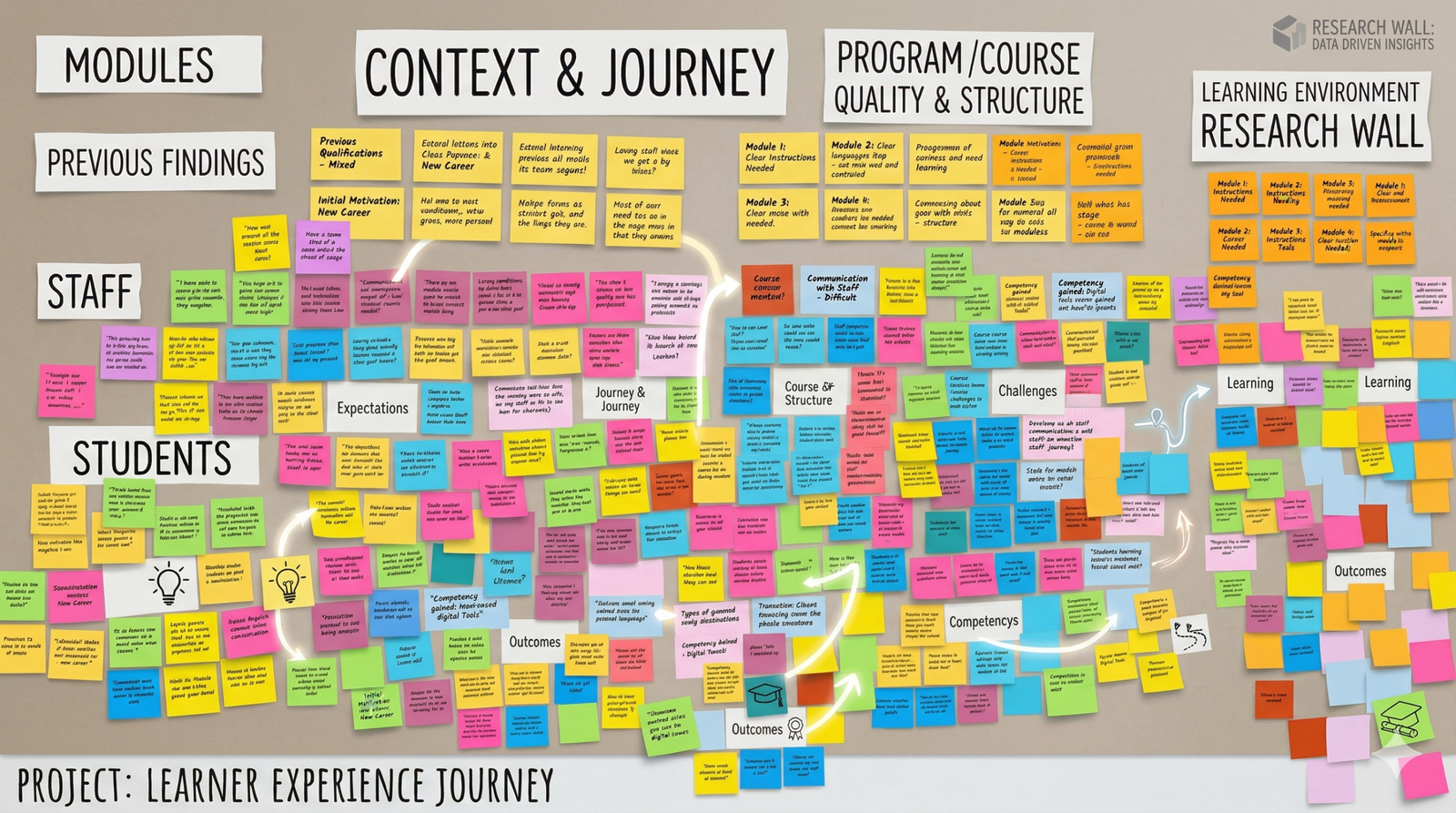
The project used a full HCD pipeline: Frame → Initial Synthesis → Qualitative Discovery → Primary Synthesis. My involvement covered Primary Synthesis — where 60 in-depth student interviews, 59 teaching staff survey responses, and 550+ data points were synthesised into insights, personas, and opportunity areas.
Synthesis methodology included participant postcards (summarising each student's story for recall weeks later), a research wall mapping verbatims across student and staff perspectives, and two synthesis workshops where the team and stakeholders worked through every verbatim together.
The Work
As UX Research Expert stakeholder, I informed Learning Design teams on what to incorporate into digital tools based on emerging insights. Key outputs: learner personas grounded in the Current Self → Desired Future Self framework; insights mapped to the student journey across four scope dimensions; opportunity areas feeding into the 2020 Design & Application phase — one of which directly informed the Emble brief.
Evidence of Impact
The research directly shaped the design brief for Emble — one of the tools built in response to the synthesised insights. The project gave RMIT's Learning Design teams their first structured, evidence-based understanding of the student experience gap — shifting decision-making from anecdote to insight across 40 current students, 10 alumni, 10 prospective students, and 59 teaching staff.
What I'd Do Differently
My involvement in the final six months meant I was working with insights already shaped by phases I wasn't part of. I'd now push to be engaged from the Framing phase — the earlier a UX research perspective is embedded, the more the methodology reflects genuine user research rigour. I'd also advocate for a longitudinal follow-up study to track whether design changes actually shifted student experience metrics in subsequent semesters.