
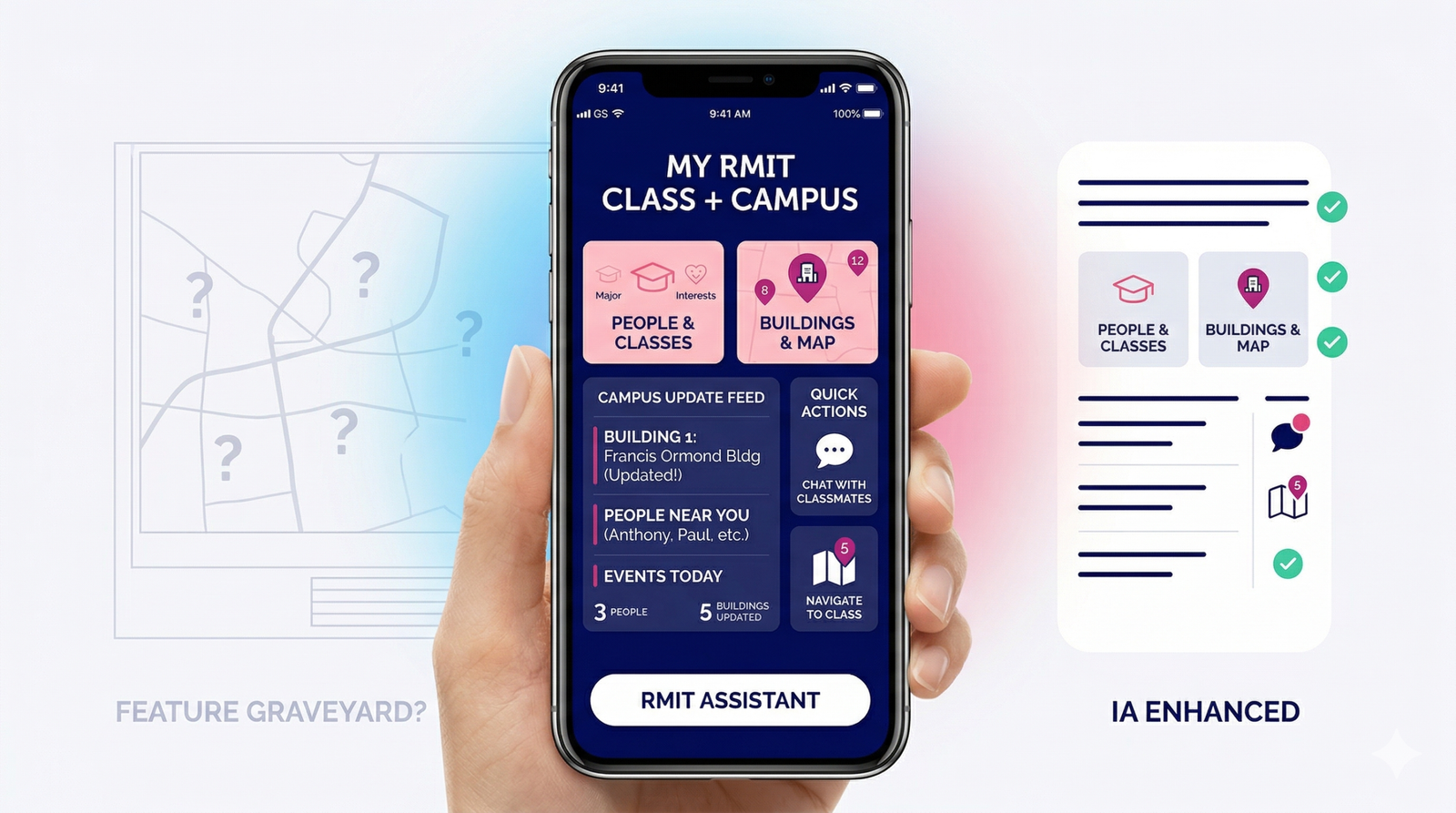
RMIT Student Assistant App: UX Audit & Enhancement
The Problem
The app had a classic feature graveyard problem — capabilities had been added over time without a coherent IA to surface them, and content had drifted out of date because there was no governance process for keeping it current. Students who tried the app once and couldn't find what they needed didn't return.
The audit needed to separate three distinct problems: structural (IA), content (accuracy and relevance), and behavioural (are students even aware these features exist and choosing alternatives instead?).
My Approach
I conducted a systematic heuristic evaluation against Nielsen's 10 usability principles, a full content audit assessing accuracy and currency of all information, and competitive benchmarking against student apps from peer universities.
Critically, I also mapped what students were using instead of the app — WhatsApp groups, Facebook groups, direct emails to admin. Understanding the alternatives revealed that the app's biggest competitor wasn't a rival app but informal peer networks, which changed what 'good' meant for the redesign.
The Work
Delivered a prioritised audit report covering: structural IA issues with recommended reorganisation, content gaps and out-of-date information with governance recommendations, feature discoverability problems with proposed solutions, and a competitive benchmarking summary. Produced an implementation-ready action plan categorised by effort and impact.
Evidence of Impact
The audit and action plan were adopted by the RMIT product team. The findings drove targeted improvements to navigation, content currency, and feature discoverability — maintaining the app's role as a valuable resource for student engagement and support.
What I'd Do Differently
I'd pair the heuristic evaluation with at least 5 contextual inquiry sessions — watching students try to accomplish real tasks in the app reveals usability issues that expert review misses. The competitive benchmarking against other university apps was useful, but the more valuable comparison turned out to be what students were using instead of the app.