Research Project
Auto-Paizo Games: Towards Understanding the Design of Games That Aim to Unify a Player’s Physical Body and the Virtual World
Most digital bodily games focus on the body as they use movement as input.
Abstract
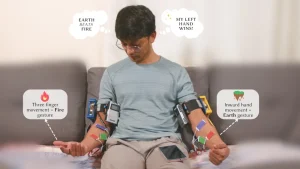
Most digital bodily games focus on the body as they use movement as input. However, they also draw the player’s focus away from the body as the output occurs on visual displays, creating a divide between the physical body and the virtual world. We propose a novel approach – the "Body as a Play Material" – where a player uses their body as both input and output to unify the physical body and the virtual world. To showcase this approach, we designed three games where a player uses one of their hands (input) to play against the other hand (output) by loaning control over its movements to an Electrical Muscle Stimulation (EMS) system. We conducted a thematic analysis on the data obtained from a field study with 12 participants to articulate four player experience themes. We discuss our results about how participants appreciated the engagement with the variety of bodily movements for play and the ambiguity of using their body as a play material. Ultimately, our work aims to unify the physical body and the virtual world.
Authors
Keywords
Collaborators