
Cred Finder: Centralising Credential Management at RMIT University
The Problem
RMIT's credential management wasn't just inefficient — it was a governance risk. When credential data lives in shared spreadsheets across HR, ITS, colleges, and RMIT Online, there's no single source of truth, no audit trail, and no way to catch errors before they reach students.
The problem I was solving wasn't 'build a better spreadsheet' — it was 'create a system where bad data is structurally impossible to submit.' That reframing changed everything about the solution.
My Approach
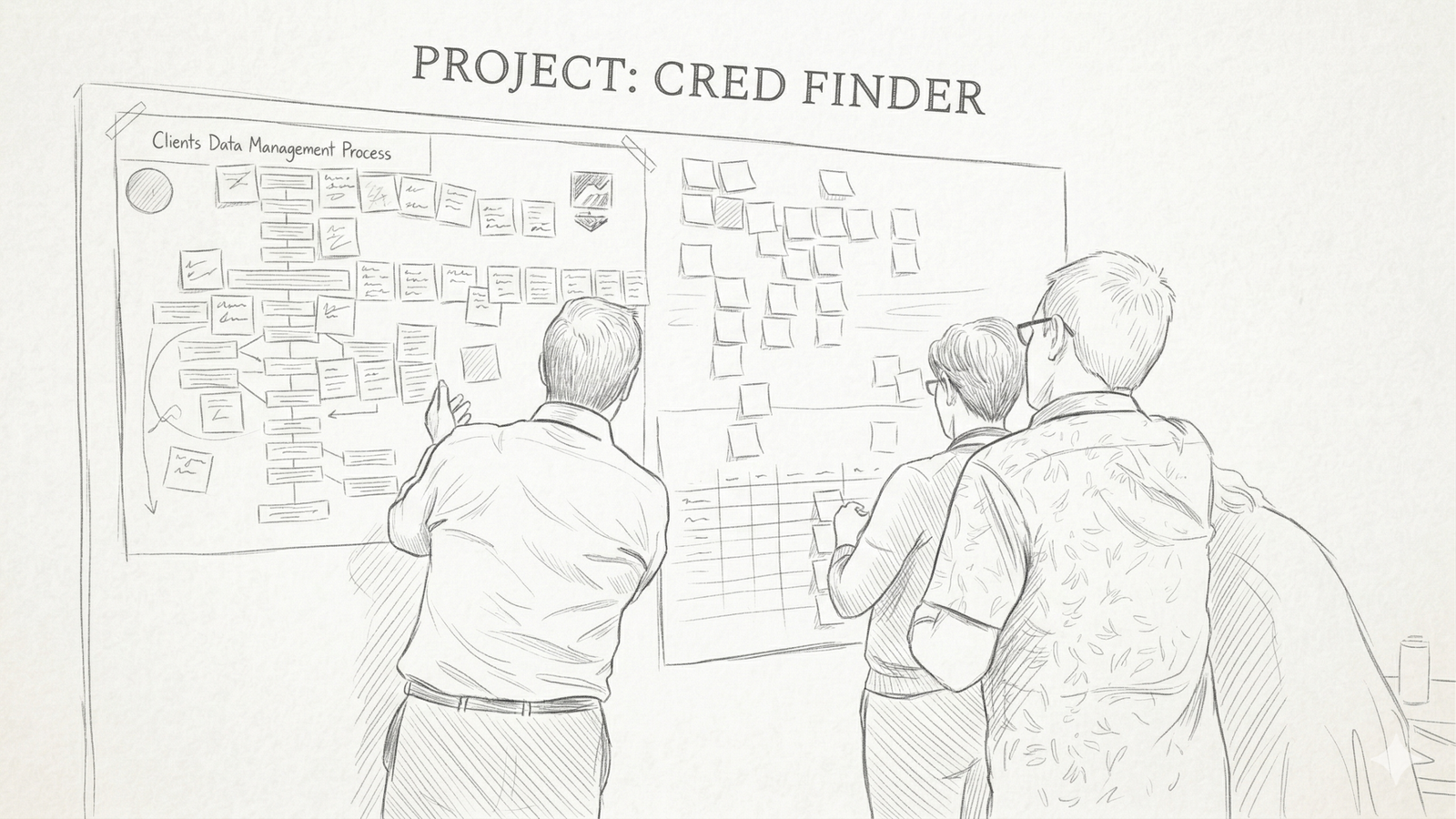
I organised and facilitated workshops with key stakeholders using a WWWWWH (Who, Why, What, Where, When, How) framework to surface pain points and align on an ideal future state. Rather than presenting a solution, I ran sessions where stakeholders mapped their own current process — making the dysfunction visible to the people who needed to approve the fix.
I iterated through five versions of process flow diagrams, progressively aligning stakeholders on a future state. I defined functional requirements collaboratively with all user groups — Product Managers, Cred Specialists, Course Coordinators, and ITS staff — ensuring every user story was captured before design began.
The Work
Delivered Cred Finder: a web tool managing the complete credential lifecycle — creation, management, embedding, delivery, and assessment. Key features: controlled data entry with validation that makes errors structurally impossible, real-time visibility for product owners, automated notifications, and reporting dashboards.
Conducted multiple rounds of UAT with the technical team, refining until the tool met the needs of all user groups. Integrated with existing delivery platforms to provide accurate, real-time data.
Evidence of Impact
Streamlined credential management across RMIT, reducing data errors and improving governance. Provided accurate real-time data enabling efficient reporting and decision-making. Supported rollout of new credential programs with improved data visibility and reduced administrative costs.
📄 Download process map (PDF)What I'd Do Differently
Five iterations of process mapping was one too many — by version three, I was optimising for stakeholder consensus rather than the best process. I'd now timebox the mapping phase more aggressively and move to low-fidelity prototyping earlier. Seeing a clickable interface consistently unlocks better feedback than reviewing flow diagrams.