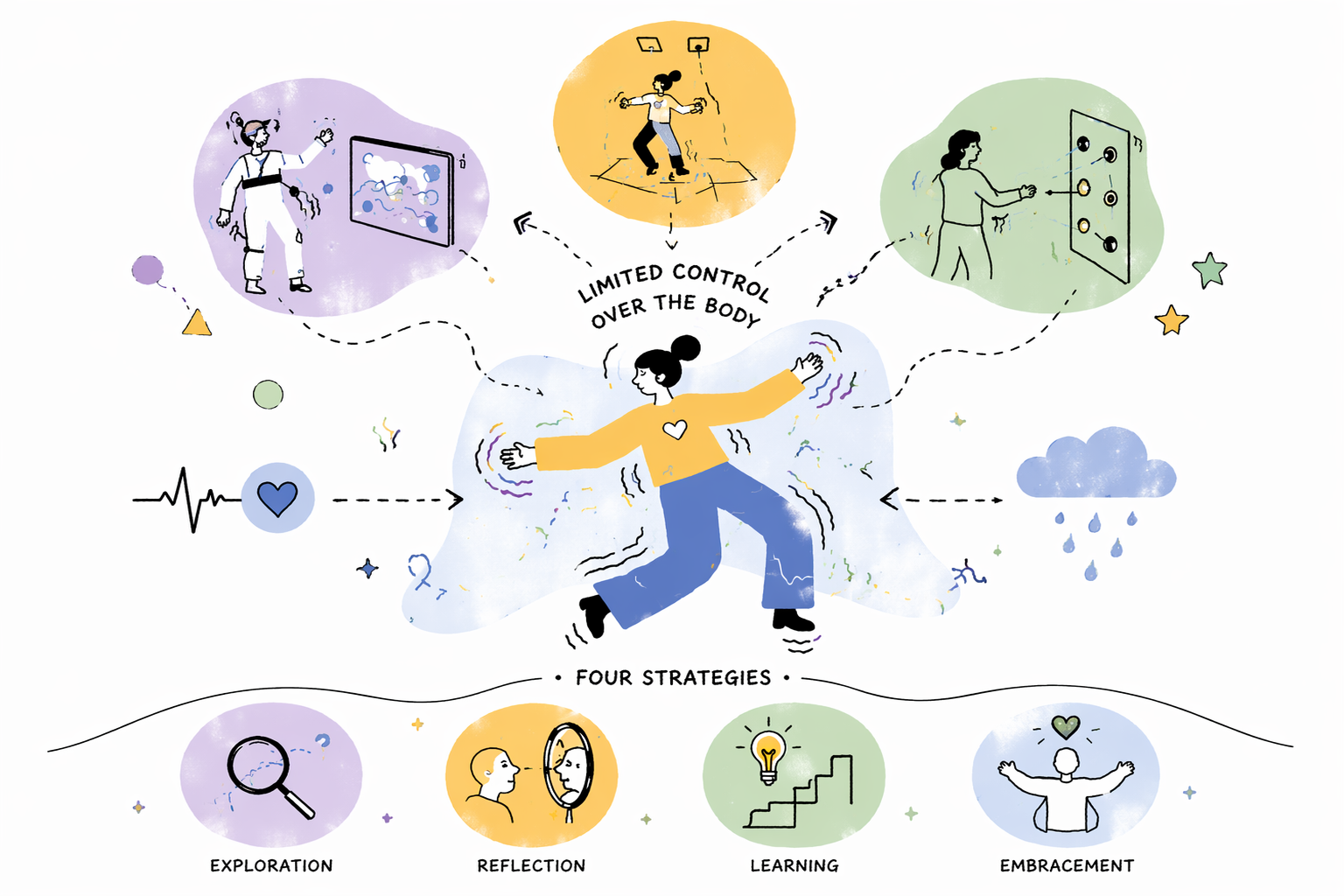
Rather than always giving players full control over their bodies, this paper explores what happens when that control is intentionally limited or shared – for example, when another bodily action triggers an involuntary movement. The authors argue this "limited control" can actually make games more interesting and reflective.
Abstract
Interest in combining interactive play and the human body, using “bodily play” systems, is increasing. While these systems primarily prioritize a player's control over their bodily actions, we see intriguing possibilities in the pursuit of “limited control over the body” as an intriguing design resource for bodily play systems. In this paper, we use three of our bodily play systems to illustrate how designers can engage with limited control over the body by varying the player's degree of indirect control (for instance, via other bodily activity and external triggers). We also propose four strategies for employing limited control over the body: Exploration, Reflection, Learning and Embracement. We hope our own work and the strategies developed from it will assist designers to employ limited control over the body, ultimately helping people benefit from engaging their bodies through play.
Authors
Keywords
Collaborators