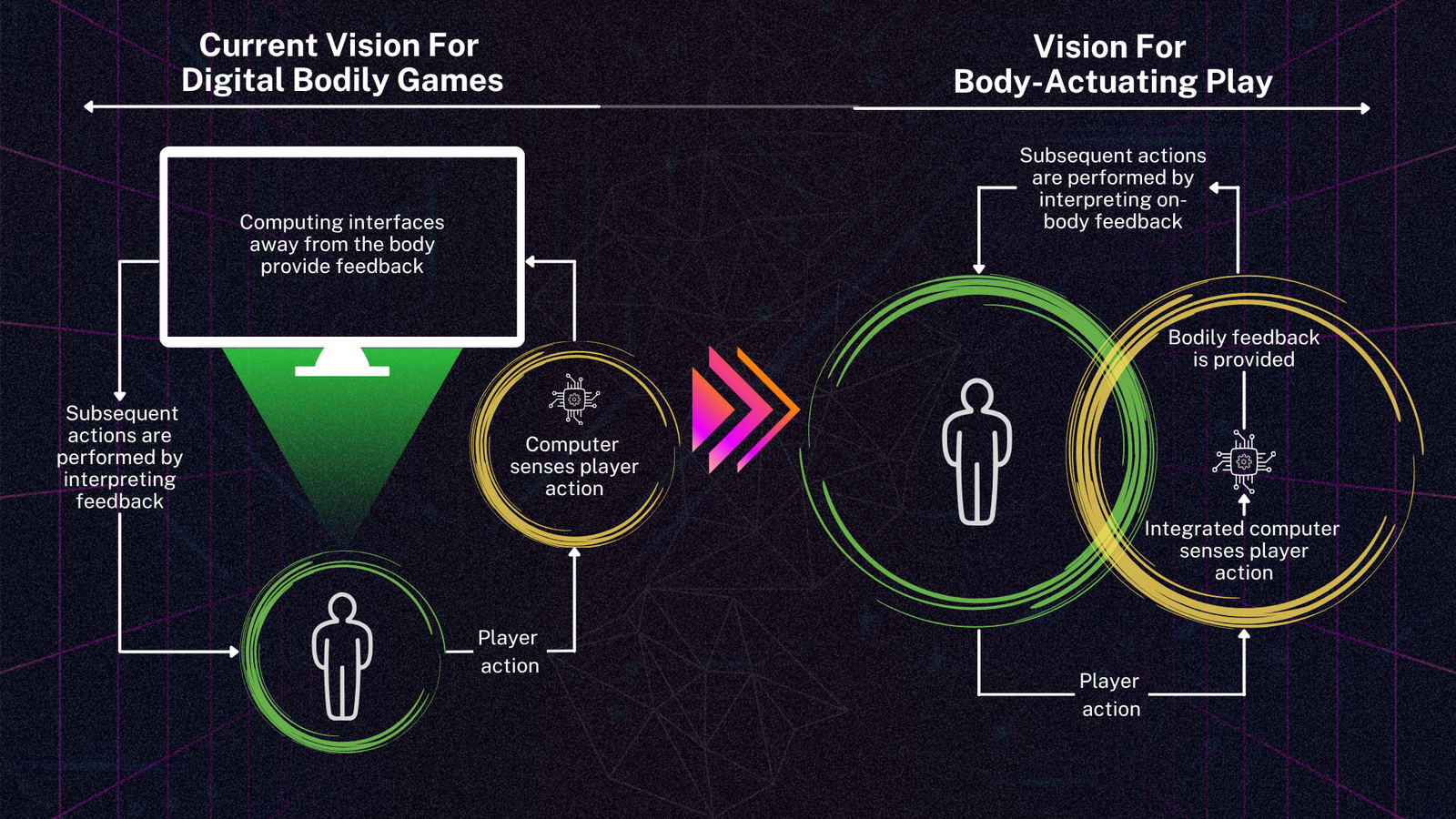
A research project building three games where the player's body serves as both the input (what you do) and the output (what happens to you) using electrical muscle stimulation. The work aims to create a design guide for this new category of games where the body is simultaneously controller and screen.
Abstract
Bodily games often use players’ physiology as input to provide output via screen-based modalities. Game design researchers could extend the use of the body as input and output (I/O) by using body-actuating technologies such as Electrical Muscle Stimulation (EMS). EMS works by passing a small amount of electricity via electrodes attached to the player’s body, contracting their muscles to actuate involuntary body movements. Our work explores this bodily I/O by creating three "body-actuated play" systems ranging from single-player to social game experiences. Ultimately, by studying the associated user experiences of these systems, we will deduce a prescriptive design framework for designing bodily games in which humans can use their bodies as input and output.
Authors
Keywords
Collaborators